The EU AI Act introduces a phased timeline for organisations developing or using General Purpose AI (GPAI) models. Understanding when obligations apply — and when they become enforceable — is essential for any business using AI today.
This evergreen guide outlines the key dates, transitional rules, and what they mean for your organisation. We keep this page updated as new guidance from the European Commission and the AI Office is released.
✅ At a Glance: Key Enforcement Dates
| Date | What Happens | Why It Matters |
|---|---|---|
| 1 August 2024 | AI Act entered into force | Legal framework officially active |
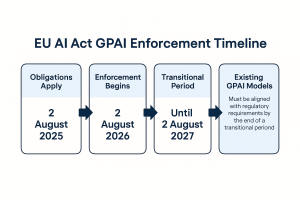
| 2 August 2025 | GPAI obligations begin to apply | Providers and deployers must comply starting this date |
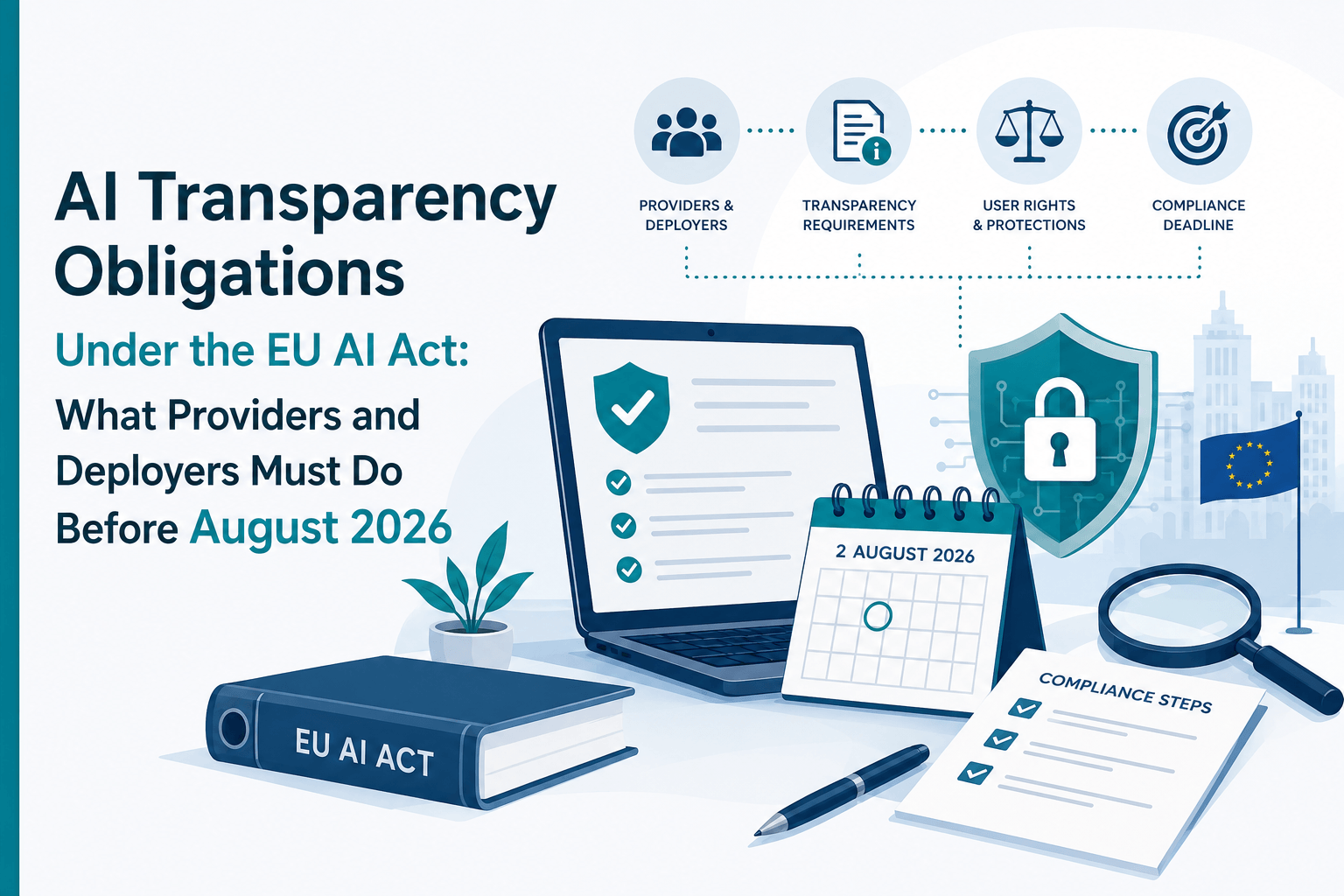
| 2 August 2026 | Enforcement powers become active | Authorities can start investigating and sanctioning |
| 2 August 2027 | End of transitional period for pre-2025 models | Legacy models must be fully aligned |
✅ 1. The AI Act Is Already in Force (Since 1 August 2024)
The legislation took effect in August 2024.
This means the legal basis is active — but not all obligations apply immediately.
For business leaders, this marks the beginning of:
-
Internal readiness planning
-
Mapping AI use
-
Preparing governance structures
-
Requesting documentation from AI providers
-
Reviewing procurement processes
Organisations that start early will be ahead of the curve.
✅ 2. GPAI Obligations Apply From 2 August 2025
From this date, organisations developing or placing GPAI models on the EU market must comply with obligations under:
-
Article 53 (documentation, transparency, copyright)
-
Article 55–56 (for systemic-risk GPAI)
-
Article 52 (obligations for deployers)
This date is critical:
✅ GPAI providers must have documentation ready
✅ Deployers must be able to demonstrate proper use
✅ Organisations should request documentation from vendors before August 2025
Although enforcement is not yet active, compliance is required.
✅ 3. Enforcement Powers Start on 2 August 2026
This is a key distinction many organisations miss:
✅ Obligations apply in 2025
✅ Enforcement begins in 2026
During this “enforcement gap,” authorities do not yet impose penalties — but they expect:
-
Good-faith preparation
-
Documented compliance efforts
-
Risk assessments
-
Internal governance processes
-
Requests made to providers for required information
⚠️ Important:
This is not a grace period.
Regulators have been very clear: the enforcement gap allows authorities to prepare — not companies to delay.
Once enforcement begins, regulators can:
-
Request documentation
-
Conduct inspections
-
Investigate incidents
-
Impose corrective actions
-
Issue fines for non-compliance
✅ 4. Transitional Period for Pre-August 2025 Models (Until 2 August 2027)
If a GPAI model was placed on the market before 2 August 2025, providers have until 2 August 2027 to bring the model into compliance.
This transitional period exists because:
-
Older models may not have complete training data records
-
Full retraining may be impossible or disproportionately costly
-
Providers may not have maintained historic documentation
✅ Transitional benefits:
-
Additional implementation time
-
Ability to justify gaps in training data
-
Allows gradual alignment with new templates and processes
✅ But providers must:
-
Document limitations
-
Explain unavailable or missing information
-
Update documentation progressively
-
Ensure transparency and copyright compliance moving forward
No model is exempt indefinitely.
✅ 5. What This Means for Organisations Using GPAI Today
If your organisation deploys AI systems built on GPAI models, the timeline affects you directly.
✅ Between now and August 2025
-
Identify GPAI systems in use
-
Request documentation from providers
-
Update procurement templates
-
Build basic governance processes
✅ Between August 2025 and August 2026
-
Ensure compliance is demonstrable
-
Document your risk assessments
-
Evaluate whether any fine-tuning may reclassify you as a provider
-
Treat this year as “pre-enforcement audit” time
✅ From August 2026
-
Expect regulator engagement
-
Maintain audit-ready records
-
Prepare for documentation requests
✅ By August 2027 (for legacy models)
-
Ensure pre-2025 GPAI is fully aligned
-
Address missing information with justified explanations
✅ Symmetry Compliance: Helping You Stay Ahead of the Timeline
At Symmetry Compliance, we help organisations:
-
Understand their role under the AI Act
-
Evaluate which AI systems are GPAI
-
Build compliance roadmaps aligned with the timeline
-
Prepare governance processes and documentation
-
Engage with vendors to obtain the right information
-
Reduce risk without slowing innovation or operations
If you want a clear action plan for your organisation, we’re here to help.
👉 Contact us for an AI Act readiness consultation.
✅ Disclaimer
This article provides general information for educational purposes only and does not constitute legal advice. Compliance requirements vary based on specific circumstances. For tailored guidance, consult legal counsel and official resources of the European Commission, the AI Office, and national authorities.