The countdown to 2 August 2026, when the EU AI Act Article 50 transparency obligations begin to apply, is entering its final weeks. The European Commission's Code of Practice on Transparency of AI-Generated Content has moved from draft to final, a grandfathering rule for existing generative AI systems has been confirmed, and a new interoperability deadline has emerged for February 2027. This briefing gives you the current picture: what changed, exactly what providers and deployers must each do, and the concrete steps to take before the deadline.
What’s New in the EU AI Act Article 50 Transparency Rules
Three developments matter most for your compliance planning right now:
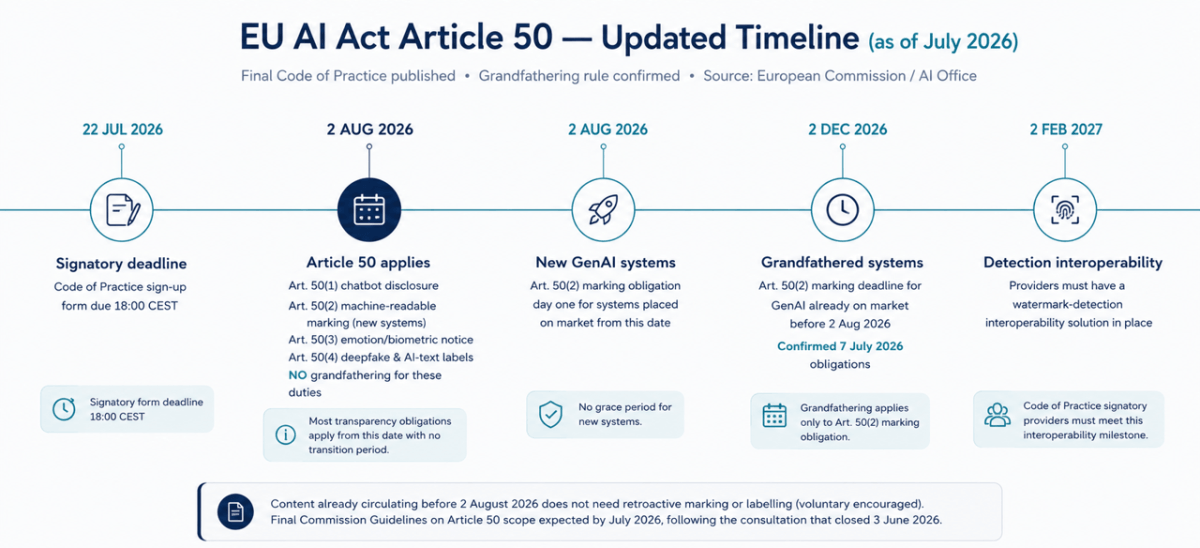
- Final Code of Practice: The Code of Practice on Transparency of AI-Generated Content has been published in final form. It is no longer a draft. Organisations wishing to be listed among the initial signatories must submit their signatory form by 18:00 CEST on 22 July 2026, just days away.
- Grandfathering confirmed: The grandfathering rule for Article 50(2) marking is now confirmed: generative AI systems already on the EU market before 2 August 2026 have until 2 December 2026 to comply with machine-readable marking. Systems placed on the market from 2 August 2026 onwards must comply from day one; there is no grace period for new systems.
- New interoperability deadline: The Code introduces a new deadline: signatory providers must have a watermark-detection interoperability solution in place by 2 February 2027, ensuring that marking techniques can be read across different providers' systems.
The Complete Timeline, Every Date That Matters
The obligations under Article 50 now follow a more granular timeline than originally understood in May. The chart below reflects the confirmed position as of mid-July 2026.
Why the dates diverge by obligation
Not every Article 50 duty follows the same clock. Articles 50(1), 50(3) and 50(4), interactive AI disclosure, emotion/biometric notice, and deepfake/AI-text labelling, apply from 2 August 2026 with no transition period whatsoever, regardless of when the AI system was first placed on the market. Only Article 50(2), the machine-readable marking obligation, benefits from the grandfathering rule, and only for systems that were already on the market before the application date.
EU AI Act Provider vs Deployer Obligations
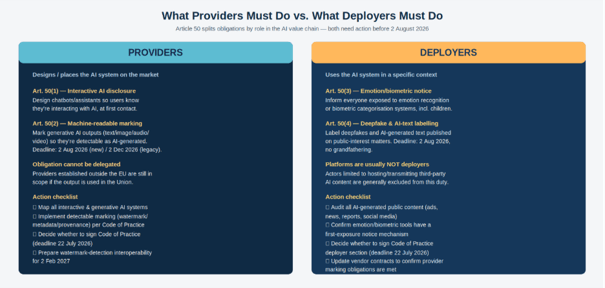
The most common source of confusion is which role, provider or deployer, an organisation occupies for a given AI system, since the two carry different duties. The chart below sets these out side by side.
If you are a provider
You design or place an AI system on the EU market. Your Article 50 duties are Art. 50(1) (ensure interactive systems disclose their AI nature to users) and Art. 50(2) (mark generative AI outputs so they are machine-detectable). These obligations sit with you regardless of where you are established; providers outside the EU are still in scope if the system's output is used within the Union. Crucially, these obligations cannot be contractually transferred to your customers or downstream deployers.
If you are a deployer
You use an AI system in a specific operational context, in HR, marketing, customer service, or content publishing, for example. Your Article 50 duties are Art. 50(3) (inform people exposed to emotion recognition or biometric categorisation systems) and Art. 50(4) (label deepfakes and AI-generated text published on matters of public interest). One important exception: if your role is limited to hosting or transmitting AI-generated content created by a third party, as on most platforms, you are generally not considered a "deployer" for this purpose, though you are still expected to preserve any marks the provider applied.
If you are both
Many organisations occupy both roles simultaneously, for example, a company that builds its own generative AI tool (provider) and also uses that tool to produce marketing content published to the public (deployer). In that case, both sets of obligations apply, and your compliance mapping should treat each AI system's use case separately rather than assuming a single organisational status covers everything you do.
Quick Reference: The Four Obligations
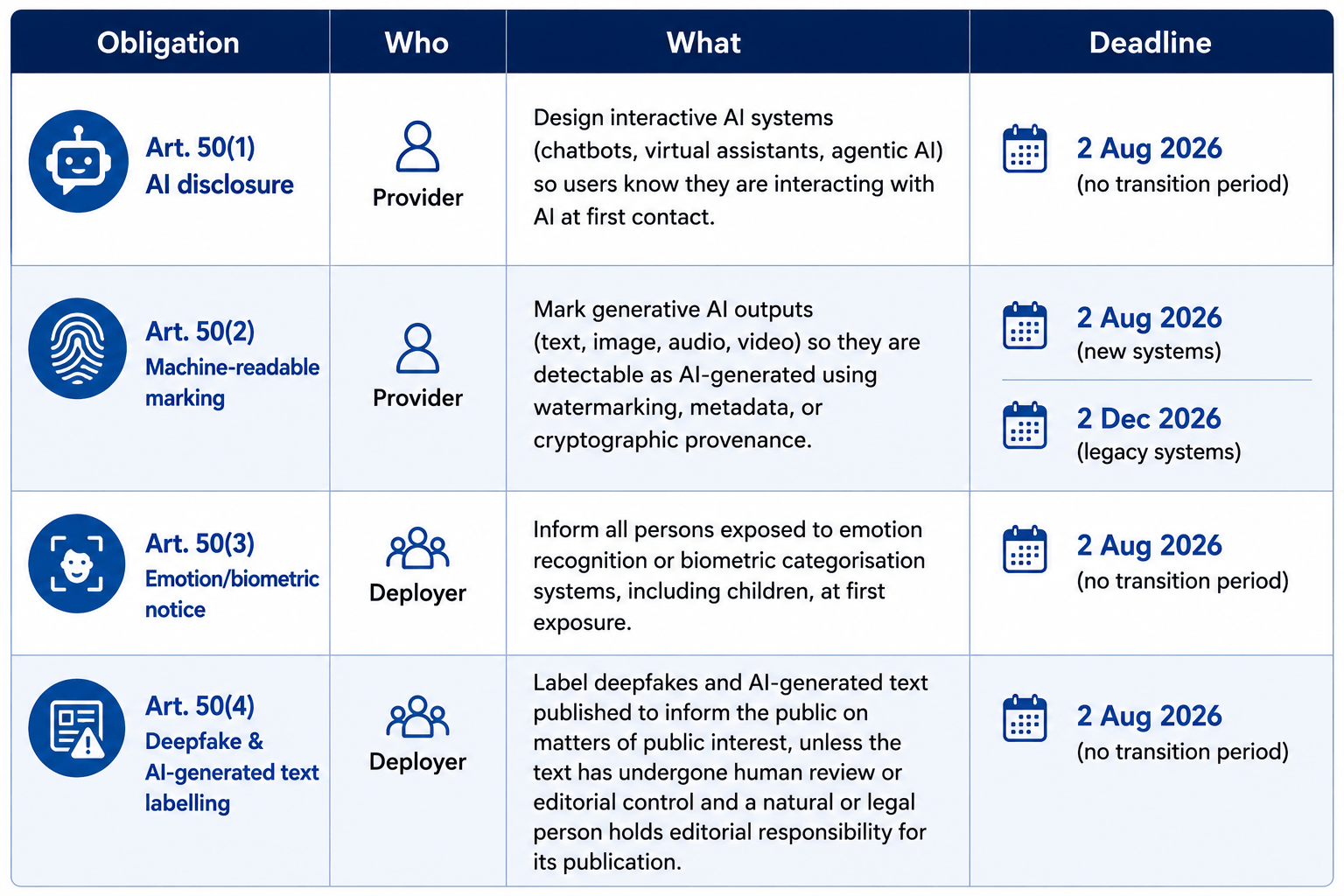
Figure 3, The four distinct obligations under Article 50 and who bears them
Figure 3, The four distinct obligations under Article 50 and who bears them.
The Compliance Architecture, Now With a Final Code
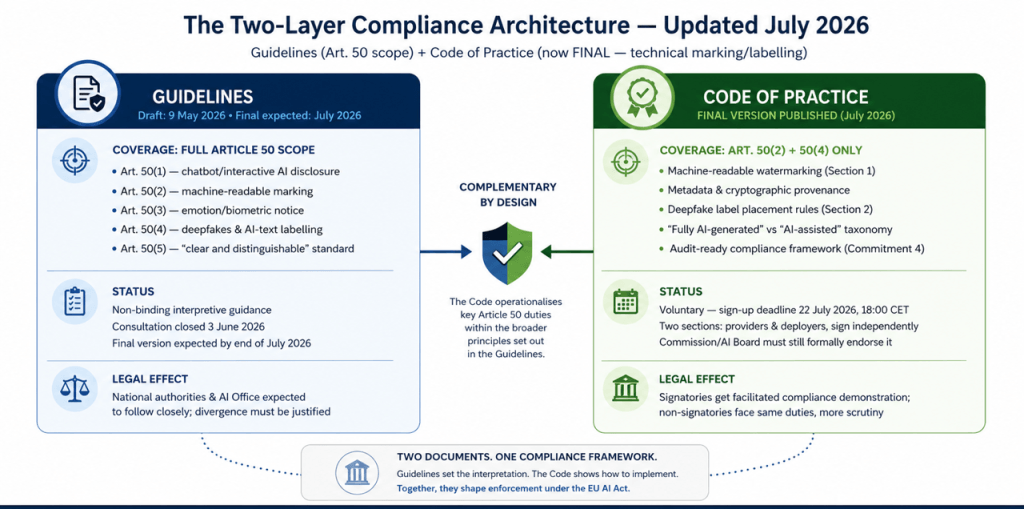
The relationship between the two governing instruments has become clearer now that the Code of Practice has moved from draft to final.
Should you sign the Code of Practice?
Signing is voluntary, and the Code consists of two independent sections, one for providers, one for deployers, so that you can sign only the section relevant to your role. Signatories benefit from a facilitated route to demonstrating compliance: adherence to the Code is expected to serve as the main reference point for regulatory assessments. Non-signatories face the same underlying legal duties but must demonstrate compliance through other means and can expect closer scrutiny. Adherence is not, however, a guarantee of compliance; competent authorities remain responsible for the final assessment of whether Article 50 has actually been met. Note also that, following the Code's publication on 10 June 2026, the Commission and the AI Board are still assessing its adequacy; adherence becomes a formally recognised route to demonstrating compliance only once that assessment concludes positively.
Bear in mind that the Code itself acknowledges a hard technical truth: no single marking technology currently satisfies all statutory requirements (effectiveness, interoperability, robustness, reliability) at once. Forensic detection tools are not yet considered fully reliable, and shared evaluation benchmarks are still emerging. A defence-in-depth approach, combining watermarking, metadata and provenance techniques, is the realistic expectation, not a single silver-bullet fix.
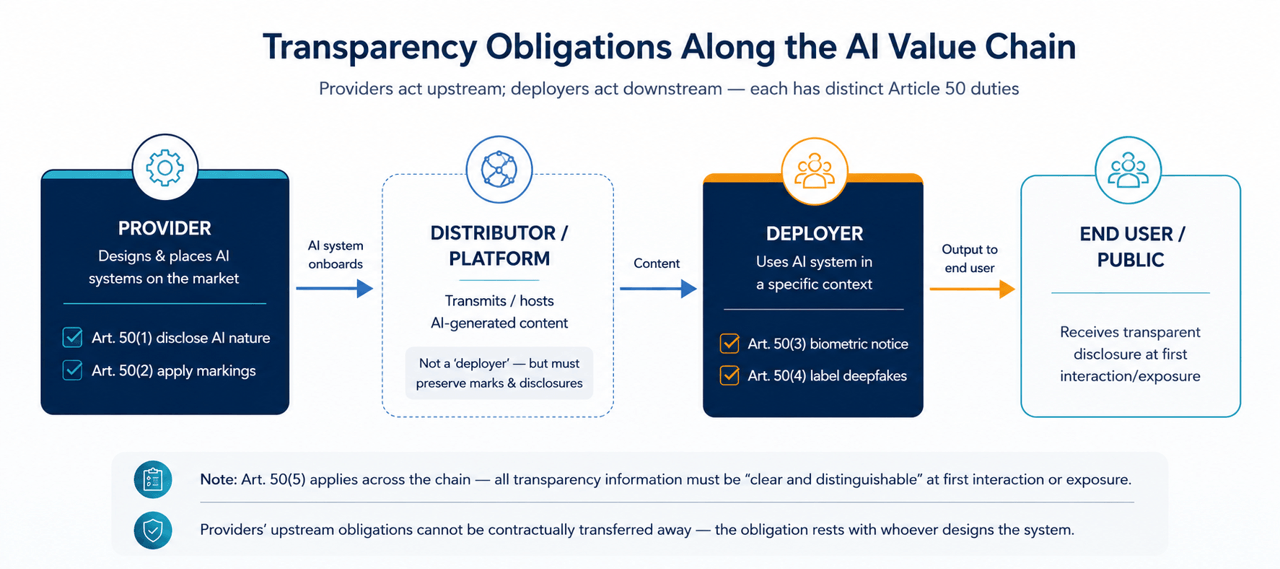
A reminder for procurement and vendor-management teams: provider obligations under Art. 50(1) and (2) cannot be transferred to customers by contract. The duty follows whoever designs and places the system on the market. If you are a deployer relying on a third-party generative AI tool, your practical safeguard is contractual: requiring written confirmation that the provider has fulfilled its marking obligations and building that confirmation into future vendor due diligence.
EU AI Act Article 50 Compliance Checklist Before 2 August 2026
With the deadline now weeks away, prioritise the following in order:
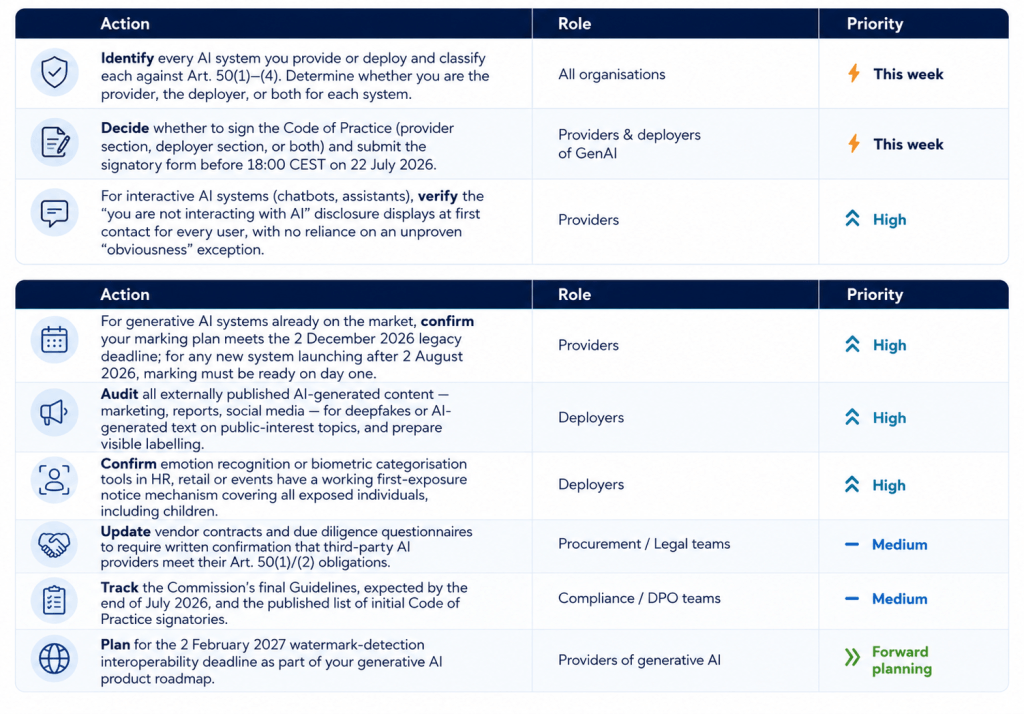
Key Takeaway
Organisations that provide or deploy AI systems should identify which Article 50 transparency obligations apply to each system well before 2 August 2026. Mapping provider and deployer responsibilities, implementing appropriate disclosure and marking measures, and documenting compliance decisions will help organisations prepare for enforcement under the EU AI Act.
How Symmetry Compliance can help
Your Content Goes Here
Official Sources and Further Reading
- European Commission, Code of Practice on marking and labelling of AI-generated content (final version, published 10 June 2026). digital-strategy.ec.europa.eu/en/policies/code-practice-ai-generated-content
- European Commission, Draft Guidelines on Article 50 AI Act, 8 May 2026. digital-strategy.ec.europa.eu/en/library/draft-guidelines-implementation-transparency-obligations-certain-ai-systems-under-article-50-ai-act
- European Commission, Consultation on Draft Article 50 Guidelines (closed 3 June 2026). digital-strategy.ec.europa.eu/en/consultations/consultation-draft-guidelines-transparency-obligations-under-ai-act
- EU AI Act, Regulation (EU) 2024/1689, Article 50, Official Journal of the European Union. eur-lex.europa.eu
- EU AI Act Service Desk, Article 50 summary. ai-act-service-desk.ec.europa.eu/en/ai-act/article-50
- Department of Enterprise, Trade and Employment (Ireland), EU AI Act guidance. enterprise.gov.ie/en/what-we-do/innovation-research-development/artificial-intelligence/eu-ai-act/
- AESIA , Agencia Española de Supervisión de la Inteligencia Artificial (Spain). aesia.digital.gob.es
Disclaimer: This blog post is provided by Symmetry Compliance Group for general information purposes only and reflects the position as of 15 July 2026, based on the final Code of Practice on Transparency of AI-Generated Content and the draft Guidelines published by the European Commission on 8 May 2026 (final version expected end of July 2026). Nothing in this post constitutes legal advice. For advice specific to your organisation, contact us at info@symmetrycompliance.ie.