Executive Summary
A Fundamental Rights Impact Assessment (FRIA) is a mandatory assessment under Article 27 of the EU AI Act for deployers of certain high-risk AI systems.
The purpose of a FRIA is to identify, evaluate, and mitigate potential impacts on fundamental rights before an AI system is deployed.
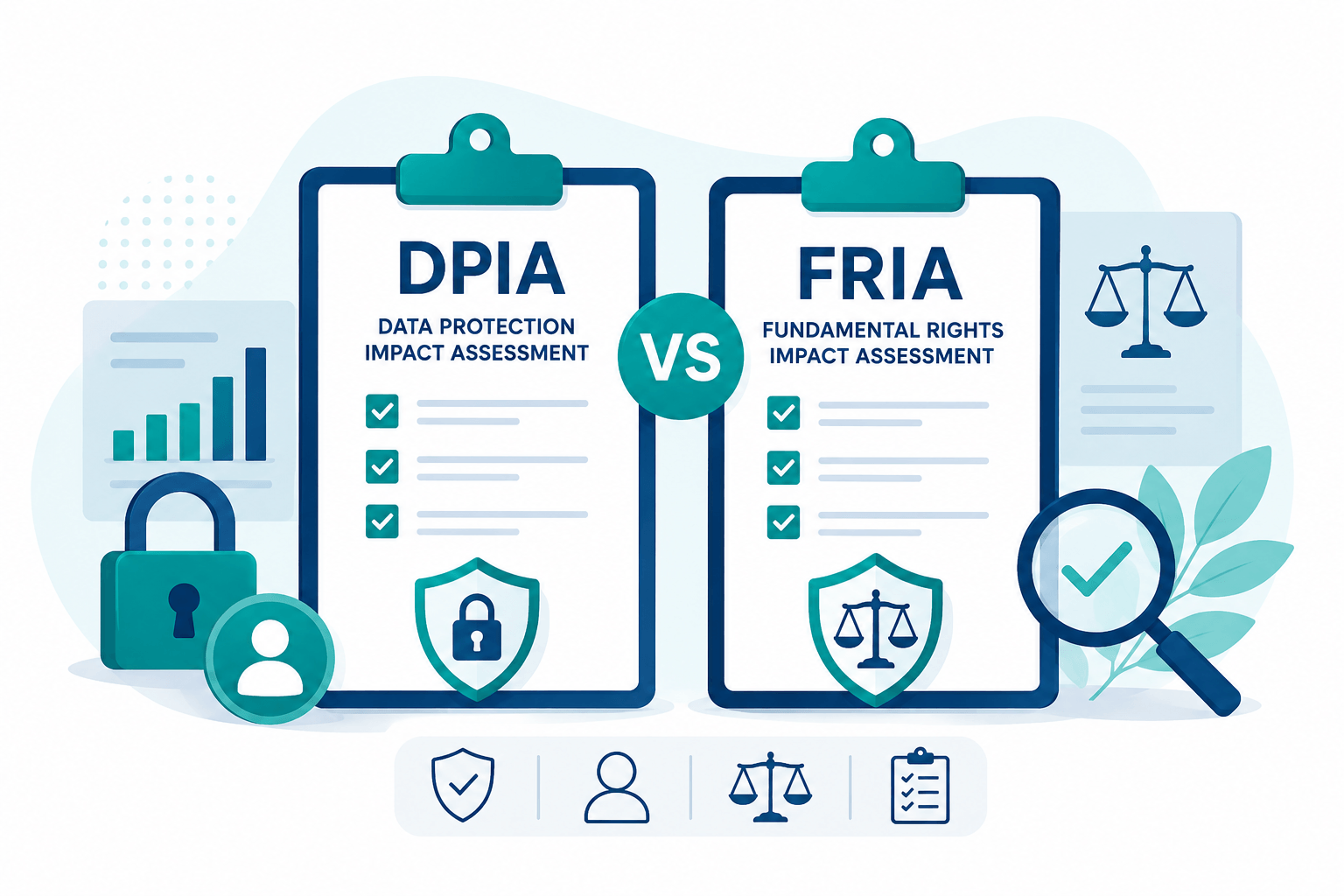
Unlike a Data Protection Impact Assessment (DPIA), a FRIA examines a broader range of rights, including equality, non-discrimination, human dignity, freedom of expression, workers’ rights, and access to justice.
FRIA vs DPIA
A DPIA and a FRIA overlap but are not interchangeable. A DPIA, required under Article 35 GDPR, focuses on risks arising from the processing of personal data — lawfulness, necessity, proportionality, and data security. A FRIA, required under Article 27 of the AI Act, looks at the wider set of fundamental rights an AI system can affect, including rights that have nothing to do with personal data, such as freedom of expression, workers’ rights, or access to justice. The two are not run in isolation from each other, however: under Article 27(4), where a deployer’s DPIA already addresses some of the same ground, the FRIA can build on and complement that DPIA rather than duplicating it. In practice, most deployers of high-risk AI systems that process personal data will need both assessments, with the FRIA extending the DPIA’s analysis into the fundamental-rights areas a DPIA does not cover. Learn more here.

Common FRIA Mistakes
 Assuming a DPIA is enough: a DPIA covers data protection risk, not the full range of fundamental rights a FRIA must assess — the two need to be read together, not treated as substitutes.
Ignoring vulnerable groups: failing to consider how the system may disproportionately affect children, people with disabilities, or other at-risk groups.
Treating the FRIA as a legal-only exercise: leaving the assessment solely to legal or compliance teams, without input from the people who understand how the system actually works.
Not involving business stakeholders: excluding the product, operations, or HR teams deploying the system, which leads to a FRIA that doesn't reflect how the system is used in practice.