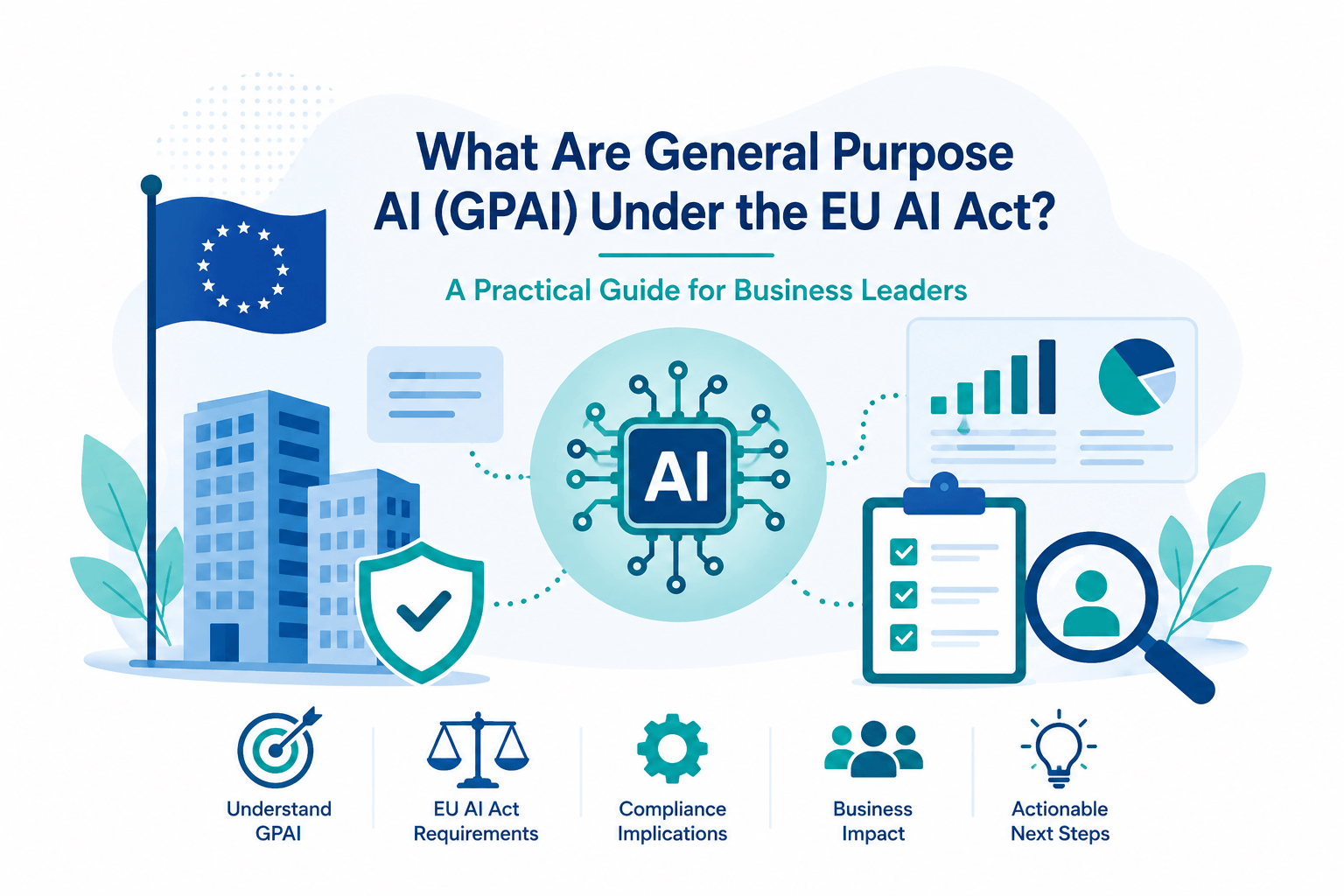
Organizations across every industry are exploring AI tools that promise efficiency, innovation, and competitive advantage. But with the EU AI Act now in force, leaders must understand how AI systems are classified—especially General Purpose AI (GPAI) models, which are central to the law.
At Symmetry Compliance, we help companies navigate these requirements with clarity and confidence. This guide breaks down what GPAI means in practical terms, why the category exists, and what it means for your organization.
✅ 1. Why GPAI Matters for Your Business
The EU AI Act introduces GPAI to regulate powerful, versatile AI models that can be used across many different applications. Unlike traditional AI—built for a single task—GPAI models can:
-
Generate text
-
Answer questions
-
Translate content
-
Produce images or video
-
Support decision-making
-
Power downstream AI systems
These models sit at the foundation of many tools companies already rely on. Understanding whether you’re using GPAI (directly or indirectly) is the first step toward determining your obligations.
✅ 2. How the EU AI Act Defines GPAI
Under Article 3(63) of the AI Act, a General Purpose AI model is one that:
-
Shows significant generality
-
Can competently perform a wide range of distinct tasks
In practice, this usually means models trained on very large and diverse datasets, with the ability to generalize beyond a single use case.
Examples include:
-
Large Language Models (LLMs)
(text generation, summarization, translation) -
Multimodal models
(able to handle text, images, audio, video) -
Foundation models that support:
-
chatbots
-
search engines
-
coding assistants
-
content moderation systems
-
healthcare decision support
-
and more
-
These capabilities make GPAI incredibly valuable—but also raise new governance expectations.
✅ 3. GPAI’s Role in the AI Value Chain
GPAI models often serve as the “engine” inside many downstream applications created by other companies. Because of this, the EU AI Act assigns specific responsibilities to:
-
Providers — those who develop or place the model on the market
-
Deployers — those who integrate or use the model
The Act also references a GPAI Code of Practice, which gives practical steps for meeting transparency, copyright, safety, and security requirements.
✅ 4. Open-Source GPAI: What the Exemption Really Means
Article 53(2) introduces a partial exemption for open-source GPAI models. If a model is provided under a qualifying open-source licence and is not classified as having systemic risk, the provider is exempt from some transparency requirements.
However, two important notes for business leaders:
✅ 1. The exemption disappears if the model poses systemic risk
If a model crosses the threshold or is designated systemic by the AI Office, full obligations apply, even if it is open source.
✅ 2. Open-source providers still have responsibilities
They must still comply with:
-
Copyright law
-
Data protection legislation
-
Cooperation duties with authorities
This approach supports innovation but maintains safeguards where wider societal risks emerge.
✅ 5. What This Means for Your Organization
If your business uses AI tools built on top of GPAI models, you may not be the “provider”—but you still have responsibilities. Understanding whether a model is GPAI is the first step toward:
-
evaluating your compliance obligations
-
selecting safe and trustworthy tools
-
preparing for future reporting or documentation
-
creating internal governance policies
In our next posts, we’ll walk you through the exact obligations for providers and deployers, and how to determine whether your AI uses fall under the GPAI category.
✅ Need help navigating GPAI?
At Symmetry Compliance, we help organizations assess their AI tools, understand their obligations, and prepare practical compliance roadmaps without overcomplicating the process.
👉 Contact us to learn how we can support your compliance journey.
✅ Disclaimer
This article provides general information for educational purposes only and does not constitute legal advice. Compliance requirements vary based on specific circumstances. For tailored guidance, consult legal counsel and the official resources of the European Commission, AI Office, and national authorities.